Lessons on Global Food Crisis Campaigning
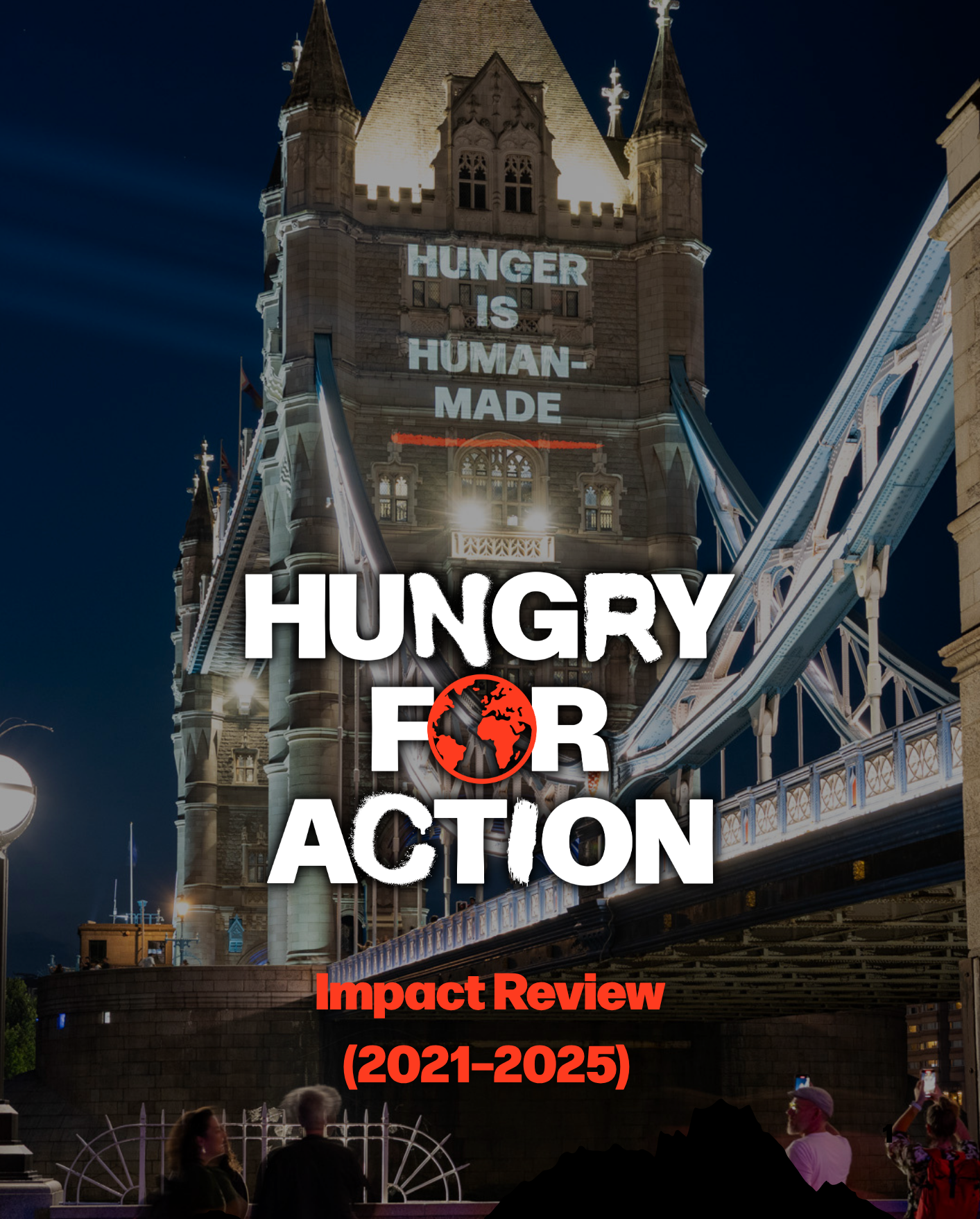
Hungry for Action (2021–2025) was a global advocacy campaign launched in response to the sharp rise in hunger driven by COVID-19, conflict, climate shocks and economic instability. At a time when solutions existed but political will and coordination were lacking, the campaign united over 60 organisations to elevate the global food crisis as a top-tier political issue and push for urgent, collective action.
Operating across major global moments, including the G7, G20, UN General Assembly, and international financial institutions, Hungry for Action helped sustain visibility of the global food crisis in high-level forums, align civil society voices, and strengthen advocacy around shared priorities: saving lives, building resilience and securing long-term food systems transformation.
This Impact Review reflects on the campaign’s contribution over its lifecycle. It examines how Hungry for Action unified a fragmented advocacy landscape, shaped narratives that reframed hunger as a political failure, and mobilised coordinated action around key initiatives such as the Global Alliance Against Hunger and Poverty. It also provides an honest assessment of where progress stalled, particularly in translating visibility into sustained political commitment and financing.
The report offers practical lessons for future global campaigning on hunger and food systems, highlighting the need for greater political leverage, more targeted strategies, and sustained investment in public engagement to turn awareness into action.
Eight Key Learnings for Future Campaigning on the Global Food Crisis:
-
Visibility is a critical foundation for action
Hungry for Action helped ensure that the food crisis remained visible in global political discussions at a time of competing crises but fell short of securing the action needed.
The opportunity: Build on this foundation by pairing visibility with targeted strategies that convert attention into concrete political and financial commitments. -
Collective action amplifies influence
The campaign demonstrated the power of bringing together a diverse coalition to elevate shared priorities and strengthen advocacy reach.
The opportunity: Harness coalition strength while sharpening focus around a smaller number of shared priorities to drive deeper impact. -
Strong narratives can reshape how issues are understood
Framing hunger as human-made helped shift the conversation and reinforce that solutions are within reach.
The opportunity: Pair compelling narratives with clear policy asks and political strategies to translate momentum into measurable change. -
Sustained focus on financing can unlock progress
The campaign helped highlight the scale of the financing gap and the need for increased investment in food security and nutrition.
The opportunity: Build more targeted and sustained advocacy aimed at financial decision-makers and institutions. -
A changing landscape creates new entry points for influence
Power is increasingly distributed across national governments, financial institutions and regional actors.
The opportunity: Combine global coordination with more targeted national and institutional strategies to engage where decisions are made. -
Campaigning models are evolving and can be strengthened
Hungry for Action showed the value of coordinated global campaigning while highlighting areas for evolution.
The opportunity: Design more focused, adaptive campaigns aligned to where influence can be most effective.
What Comes Next?
Hungry for Action demonstrates that coordinated coalition campaigning on the global food crisis can elevate issues, align actors and shape narratives at scale.
Future efforts should build on these foundations, becoming more focused, more targeted and more closely aligned with where decisions are made. This means combining visibility with sharper political strategies, compelling longer-term narratives, and engaging directly with the institutions that control policy and financing.
For organisations working across hunger, nutrition and food systems, this is a moment to build on what has been achieved and adapt for greater impact. The challenge ahead is not just to sustain attention on the food crisis, but to convert that attention into lasting change.