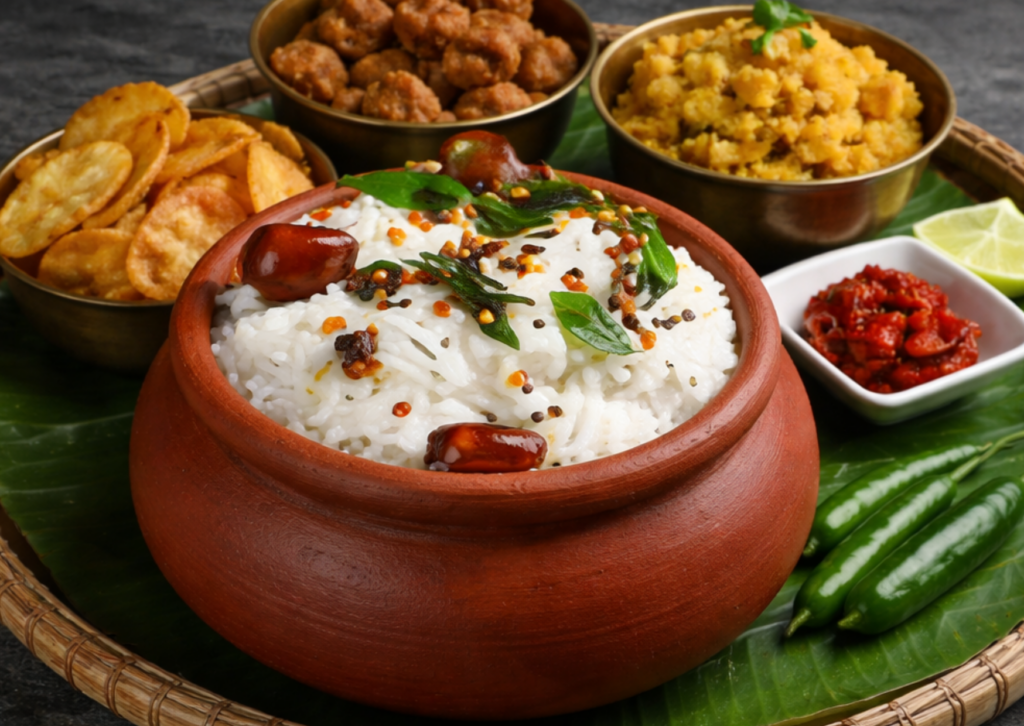
Pakhala Bhata is one of the most historically grounded and climatically intelligent dishes from eastern India, particularly the state of Odisha. At its simplest, it consists of cooked rice soaked or lightly fermented in water, seasoned with salt, yoghurt, green chillies, curry leaves or roasted cumin, and served with fried vegetables, badi (sun-dried lentil dumplings) or fish. Yet reducing it to “rice in water” misses its cultural and ecological depth.
In agrarian Odisha, rice was the staple crop and the tropical coastal climate was intensely hot and humid. Preservation mattered. Soaking rice in water served three purposes: it prevented wastage, cooled the body during punishing summers, and encouraged natural lactic fermentation. That fermentation enhanced B vitamins, improved mineral absorption and introduced beneficial bacteria. Long before probiotic drinks entered supermarket shelves, Odia farmers were sustaining gut health through inherited knowledge.
“In its simplicity, Pakhala Bhata demonstrates how climate, agriculture, ritual and nutrition can converge in a single bowl, proof that culinary intelligence often grows not from novelty, but from continuity.”
Pakhala, however, is not merely rural sustenance. It carries ritual weight in the community. It is offered as part of the bhoga (food offered to a deity) at the Jagannath Temple, whose vast ritual kitchen ranks among the largest temple food systems in the world. Pakhala features among the Chhapan Bhog, the 56 daily offerings of food made to the deity. In Odisha, temple cuisine shapes identity; what is cooked in the Jagannath kitchen shifts from just being necessity to sanctity.
Climatically, the dish is almost engineered for survival. Odisha’s summer temperatures frequently cross 40°C. Pakhala’s high water content aids hydration, its gentle acidity supports digestion, and its minimal oil content keeps it light on the body. There is even a contemporary celebration, Pakhala Dibasa, observed on 20 March (it was declared on 20 March 2011 by popular initiative), reaffirming the dish’s seasonal and cultural significance.
Compared with richer, heavily spiced preparations, Pakhala is restrained and environmentally responsive. It reflects cuisine shaped by ecology rather than fashion.
Pakhala is a way of cooking that supports many of the thematic areas of the Chef’s manifesto Action Plan. It minimises waste, relies on local ingredients and delivers simple, nutritious food with very little resource.’ Traditionally prepared using leftover rice soaked overnight, it minimises food waste and extends the life of a staple ingredient through natural fermentation rather than energy-intensive preservation. Its strong association with Odisha’s summer climate and reliance on locally grown rice and seasonal accompaniments reflect a cuisine shaped by place and season rather than fashion.
At its core, the dish is overwhelmingly grain-based and often entirely vegetarian, demonstrating a clear plant-forward foundation. Requiring only rice, water and minimal seasoning, it remains inexpensive, hydrating and nutritionally beneficial, offering simple, affordable nourishment across socio-economic groups.
Variations
Several forms have evolved over time:
- Saja Pakhala – freshly prepared rice soaked in water.
- Basi Pakhala – fermented overnight.
- Dahi Pakhala – enriched with yoghurt.
- Jeera Pakhala – tempered with roasted cumin and chillies.
Each variation signals subtle shifts in preference and context: fresh versus fermented, household versus ritual preparation, rural continuity versus urban adaptation. Refrigeration has shortened fermentation time in many modern homes, though traditional overnight fermentation remains common in rural Odisha.